• Mind
  • Body
  • Sight
  • Hearing
  • Smell
  • Taste
  • Touch
  • Skip to primary navigation
  • Skip to main content
  • Skip to primary sidebar

Living with Scleroderma

Reflections on the Messy Complexity of Chronicity

  • Home
  • About
    • Privacy Policy
  • What Is Scleroderma?
  • Resources
  • Show Search
Hide Search

resilience

Purple Thumb Challenge

Evelyn Herwitz · June 22, 2021 · 1 Comment

I have never been good at keeping houseplants. I’m most successful with forgiving plants that don’t need much water or attention, like the snake plant that lives on our kitchen table. Every few weeks I remember to soak it in the kitchen sink, give it a good misting, and then leave it be until the next time I remember. It never seems to mind.

All that is about to change. For a combined birthday-Mother’s Day gift this year, Al surprised me with a trip to a bonsai greenhouse last month. I walked around all the many different bonsai trees for sale, but didn’t see one that really struck my fancy. Speaking with one of the staff, however, we found out that I could take a workshop and start my own.

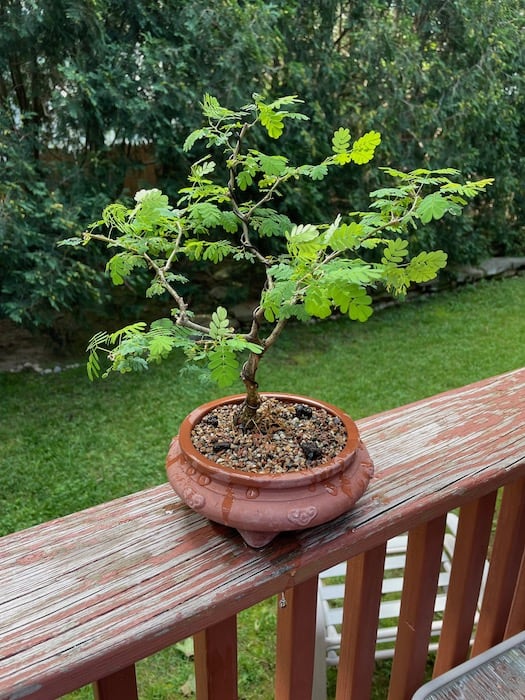
Of all the suitable species, I was most taken by a tree with very delicate, compound leaves that looked like tiny water droplets. This, we learned, was a Brazilian Rain Tree. The greenhouse had an exquisite specimen that turned out to be 75 years old. Something to aspire to, certainly. They were getting a new shipment in mid-June, so I signed up for a workshop on Father’s Day. Al was happy to come along and watch.

Meanwhile, I bought a book about bonsai to learn more. And discovered how much care is actually involved. Bonsai need daily watering and lots of attention. It’s a bit daunting for someone with a purple thumb. But I’m intrigued by the artistry that’s involved to train a tree, in miniature, into a living sculpture that honors nature.

So, on Sunday, we went to the workshop. I found a little Brazilian Rain Tree and a pretty terracotta pot, and following our teacher’s instructions, set to work.

You must first set up the pot with wires and a piece of mesh in the bottom—the wires are used to hold the bonsai roots in the shallow pot. Then you add a layer of very porous bonsai soil. Next comes removing the tree from its pot. You have to clear part of the topsoil to reveal some of the roots—this is essential to bonsai aesthetics—then poke away soil that is entwined with about two-thirds of the lower root system, and trim back the longest roots.

Then you place the tree in the pot and spread out the remaining root system, twist the wires in place to stabilize the tree, and fill the rest of the pot with more topsoil. My teacher had to help me with some of this, because my hands aren’t quite strong enough. But I did much of the prep.

Then came some pruning (Brazilian Rain Trees have thorns) and learning how to clip away deadwood. The next-to-last step involved wrapping a bendable wire around the trunk and up one branch that we bent into a curving upright stance—to train it as an apex for the tree’s eventual shape. Most of this I was able to do myself.

Now it was time to soak it with water, essential for my little tree’s survival. And it was done. I was really pleased with the result. And hoping I wouldn’t kill it.

Back home, all afternoon and evening, I kept checking the soil to see if it needed more water. Then I started to worry, because its leaves were no longer open to the light, but seemed to be drooping. Fortunately, a quick bit of Internet research revealed that Brazilian Rain Trees close their leaves in diminished light and at night, and open them in the day. So far, so good.

And so, I begin my adventure as a bonsai gardener. I understand this can become quite an addictive pastime. Already I feel a special relationship to my little tree and look forward to tending it and watching it grow. With persistence and some luck, maybe I’ll turn my purple thumb green, after all.

Evelyn Herwitz blogs weekly about living fully with chronic disease, the inside of baseballs, turtles and frogs, J.S. Bach, the meaning of life and whatever else she happens to be thinking about at livingwithscleroderma.com. Please view Privacy Policy here.

Share this:

  • Share
  • Email a link to a friend (Opens in new window) Email
  • Print (Opens in new window) Print
  • Share on Facebook (Opens in new window) Facebook
  • Share on X (Opens in new window) X
  • Share on LinkedIn (Opens in new window) LinkedIn

Filed Under: Body, Mind, Sight, Touch Tagged With: finger ulcers, mindfulness, resilience

Make Way for Ducklings

Evelyn Herwitz · June 15, 2021 · 1 Comment

I haven’t seen my sister in two years—that is, until this Sunday, when we got together for a beach-side picnic in Maine. She and my brother-in-law had finally been able to venture east (delayed a year due to Covid) to visit their eldest daughter and her husband. So Al and I and our eldest daughter drove up to see them for the afternoon. The weather cooperated, the food was delicious, and it was great to visit again, in person.

Despite all that has elapsed in the past two years, however, it also felt as if we were just catching up, like we always have. There is something very odd about how time collapses in our post-vaccination transition. For me, at least, there are no crashing cymbals or pyrotechnics when I get together again with people I’ve missed. It’s simply as if we are picking up where we left off—a good thing, but surprising, all the same.

We’ve all changed, of course, one way or another, in surviving a once-in-a-century (I hope) global pandemic. For some, the experience has been gut-wrenching, an utter up-ending of home, work, and all they hold dear. I and my loved ones have been most fortunate, staying well, maintaining income, feeling safe overall as we’ve learned important lessons about patience and persistence. We’ve taken advantage of robust means of keeping in touch that mitigate long separations. All of this contributes, I suppose, to the surprising ordinariness of our Sunday reunion.

My sister and I took a walk along the beach, settling on a rocky outcropping to watch several broods of ducks riding the waves. This was actually the most surprising aspect of our visit—each pair of mature ducks (I’m guessing, from my field guide, American black ducks) was followed by at least a dozen ducklings, paddling along in a row. There must have been 50 or 60 ducklings, all together, learning to traverse in choppy surf stirred by a stiff off-shore breeze.

As we watched, one brood came ashore on the rocks, peeping and flapping to shake off the sea, following their parents’ example to fluff their feathers and waddle about. They were utterly adorable.

“What do you think they’re saying to each other?” I asked my sister.

“I’m hungry!” she proposed. A good guess.

I wondered how such tiny, vulnerable creatures would survive in such rough waters. What if they were swamped by a wave? What if they were swept into one of the jutting rocks? And yet, to them, this was just a completely normal afternoon, on a sunny, windy day, on the coast of Maine, learning to swim.

We, too, have, learned to ride the waves of this pandemic year. Reuniting after months and months spent Zooming and masking and fretting about an unknown, unseen virus that could level a death blow without warning, after miracle vaccinations and boredom and relief that the worst really does seem to be behind us, at last—I can think of no better ending, and beginning, than savoring the humbling wonderment of dozens of ducklings, finding their way in the world.

Evelyn Herwitz blogs weekly about living fully with chronic disease, the inside of baseballs, turtles and frogs, J.S. Bach, the meaning of life and whatever else she happens to be thinking about at livingwithscleroderma.com. Please view Privacy Policy here.

Share this:

  • Share
  • Email a link to a friend (Opens in new window) Email
  • Print (Opens in new window) Print
  • Share on Facebook (Opens in new window) Facebook
  • Share on X (Opens in new window) X
  • Share on LinkedIn (Opens in new window) LinkedIn

Filed Under: Body, Hearing, Mind, Sight Tagged With: body-mind balance, managing chronic disease, mindfulness, resilience

Tunnel’s End

Evelyn Herwitz · June 1, 2021 · Leave a Comment

On Saturday, May 29, Massachusetts lifted most of our pandemic restrictions. In celebration, the TD Garden was packed for the playoff game between the Boston Bruins and the New York Islanders—which the Bruins won handily, 5-2.

I am not an ice hockey fan, nor would I feel safe going to an indoor arena filled to capacity, regardless of the sport. Too big a risk, too soon, in too huge a crowd. Outdoors, however, for a baseball game in good weather at the new Minor League stadium in our fair city, yes. Looking forward to that sometime in the not-too-distant future.

A week past Al’s clearance from Covid quarantine (he caught a mild case despite being immunized), we’re both doing fine, thank goodness. And the fact that I never caught it from him, due to the vaccine, has definitely given me more confidence—enough to venture indoors to a restaurant with my daughters on Sunday for a belated Mother’s Day meal. Our eldest has been immunized for months, and our youngest was finally able to get both Moderna vaccinations from the university where she works near Philly. So she came for a long Memorial Day weekend, and the three of us had a ladies’ luncheon, their treat.

It was great to get together, and it was also great to sit in a restaurant without worrying about taking off my mask. The place was busy, plenty of people, but still some spacing between tables. We sat near glass doors that did not close completely, so we also had a source of fresh air.

What surprised me was how close to normal it seemed. The waitstaff were still in masks and gloves, which I appreciated. But otherwise it felt like it’s always felt to eat out. Our focus was on the food and conversation, not on any worries about safety. I will be thrilled to put my mask collection away sometime over the summer, when the data confirms the wisdom of eased restrictions, as cases and deaths continue to decline with increased vaccination rates.

Al’s situation going forward is a bit uncertain, however. Given that his immune system is somewhat compromised, we need medical guidance about when/if it would be truly safe for him to go unmasked in crowds. Does the fact that he caught mild Covid and recovered after being fully immunized actually add to his protection? Or does it all depend on the variants that are still evolving? We don’t know, but I hope to get answers soon.

Our experience over the past couple of weeks is just one small example of how vigilance remains essential for those at greater risk, even as the light at the tunnel’s end is now visible. Memorial Day commemorates fallen soldiers, but we’d also do well to remember the 594 thousand Americans who have died from Covid since the pandemic began over a year ago. That’s more than the total number of soldiers who died in World War I, World War II and Vietnam, and on 9/11. And there are still people hospitalized and dying from this terrible disease.

As we venture out of our Covid cocoons, even as we revel in unmasked spaces, I profoundly hope and pray that the majority of my fellow citizens have learned to be more thoughtful about the health and well-being of others still at risk. Please get the vaccine if you are able and have not already, so that this very dark chapter can finally close and we can all, at last, safely move forward.

Evelyn Herwitz blogs weekly about living fully with chronic disease, the inside of baseballs, turtles and frogs, J.S. Bach, the meaning of life and whatever else she happens to be thinking about at livingwithscleroderma.com. Please view Privacy Policy here.

Image: Robert Bye

Share this:

  • Share
  • Email a link to a friend (Opens in new window) Email
  • Print (Opens in new window) Print
  • Share on Facebook (Opens in new window) Facebook
  • Share on X (Opens in new window) X
  • Share on LinkedIn (Opens in new window) LinkedIn

Filed Under: Body, Hearing, Mind, Sight, Smell, Taste, Touch Tagged With: COVID-19, managing chronic disease, resilience

This Is a Test

Evelyn Herwitz · May 25, 2021 · 4 Comments

Last week, our home became a testing ground for the efficacy of Covid vaccines. Al was vaccinated back in February, and I was fully immunized by the first week of April. He got Pfizer, and I got Moderna. We’ve been feeling quite confident and relieved since then, although we both still mask in public, as required.

However, for much of April and May, Al has been coughing. At first, I thought it was just a morning thing, but right after Mother’s Day, his cough got worse. By the next weekend, he was clearly not feeling well. No fever, but I suspected bronchitis. So a week ago Monday, he went to the doctor. Sure enough, he had Covid. While he could walk outside and even ride his bike if he wanted, he could not be around other people (except me) and had to work from home.

I, in turn, had a Covid test the day after Al was diagnosed, and was—thank goodness—negative. I took over all the grocery shopping, errands, and meal prep, which we usually share. I’ve felt fine the whole time.

Fortunately, his symptoms steadily improved. He never lost his sense of smell or taste. As all the research has shown so far, the vaccine most likely spared him from a severe case of the virus. By the end of the week, he was hardly coughing at all, and yesterday, he was cleared to be out of self-quarantine.

He was called twice by the Massachusetts Covid contact tracing team, to see how he was doing. We had already notified everyone we had been in contact with in the recent past. But I was impressed by their follow-up and grateful that we have a good system in place here.

So, how is it that Al caught the virus, even though he was fully immunized? Chances are because he doesn’t have a spleen, which is a critical organ in the body’s immune system. Years ago, when we were first married, he contracted a severe case of mononucleosis—not a terribly big deal for young people, but quite a big deal for a 35-year-old man. His spleen ruptured and had to be surgically removed. He came home from the hospital the day before our first wedding anniversary.

While bone marrow compensates for the spleen in a case like Al’s, I am making an educated guess (no research at present to define the relationship between lack of a spleen and Covid vaccine efficacy) that he probably has not been able to produce the full level of antibodies in response to the vaccine. However, current research does indicate that even in breakthrough cases like Al’s, he both had a milder case and also shed less of the virus because he was fully vaccinated. And apparently, my vaccinations have given me enough protection for whatever I was exposed to. Thank God.

I shudder to think what might have happened if he had be infected before being vaccinated. He is more vulnerable than either of us realized. Which also goes to demonstrate how effective masking and basic public health measures are in protecting us all.

Moral of the story: Vaccines do work, even if not perfectly. We dodged a big bullet. And I am very grateful that we’re both okay, as well as others we saw recently. If you haven’t been vaccinated yet, please—for you own sake and those you love—go get it. And be sure to exercise caution around others who may have compromised immune systems, regardless of your immunization status. We truly are still all in this together.

Evelyn Herwitz blogs weekly about living fully with chronic disease, the inside of baseballs, turtles and frogs, J.S. Bach, the meaning of life and whatever else she happens to be thinking about at livingwithscleroderma.com. Please view Privacy Policy here.

Image: Mufid Majnun

Share this:

  • Share
  • Email a link to a friend (Opens in new window) Email
  • Print (Opens in new window) Print
  • Share on Facebook (Opens in new window) Facebook
  • Share on X (Opens in new window) X
  • Share on LinkedIn (Opens in new window) LinkedIn

Filed Under: Body, Hearing, Mind, Sight, Smell, Taste, Touch Tagged With: COVID-19, managing chronic disease, resilience

Line of Sight

Evelyn Herwitz · May 18, 2021 · Leave a Comment

A few weeks ago, when I had my eyes dilated during my annual exam at a local optometry college, I learned some surprising news. Despite the fact that I have very dry eyes from Sjogren’s Syndrome, I might actually be able to wear contact lenses.

These are not your normal contacts, but scleral contact lenses, typically prescribed for people with irregular corneas. They are gas-permeable, but larger and lofted higher than regular contacts, essentially floating on a saline solution over the entire cornea and resting slightly beyond the iris on the white of the eye. For people with severe dry eyes, like me, they can provide constant lubrication.

So, I decided to find out more. Last Thursday, I went back to the college—which operates a teaching optometry clinic—and met with one of their dry eye faculty specialists, along with a fourth year student. Another fourth year student ended up joining us, because she had written her first year research paper on scleroderma.

There were two major questions to answer: First, could we actually get a pair of sample scleral contacts into my eyes; second, would my hands enable me to do this for myself? The lenses are inserted using a little plunger. You fill the lens with solution and then bring your eye down to it. Not an easy feat. It took three tries on each eye by the specialist, with me holding down my lower lid and him holding the upper lid and the lens-with-plunger, to get it in. But we did it.

Miraculously, I could see more clearly, just because of the moisture being trapped by the lenses, even as they were not prescription. However, the big challenge is that my upper eyelids are abnormally thick from scleroderma. Hard enough for two people to insert the contacts. Also, I could feel the lenses underneath my upper lids when I blinked—possibly because my eyelids are less flexible. And they burned a little, possibly because the whites of my eyes were drier since I didn’t need to blink as often as I normally do.

We were all excited that I could actually wear them, but this is far from a home run. The specialist gave me a 50:50 chance of eventual success, but wanted to go the distance if I was willing. There are a lot of customized adjustments he can make to the size and shape of the lenses, as well as a special coating that will keep the outside wetter and less irritating to my inner eyelid. There are also a lot of adaptive tools to enable me to insert them myself. But we’ll only know with the real thing.

Fortunately, with these lenses, there is a try-out period, and if they don’t work, I could return them for a full refund as well as a partial refund of the exam fee. The clinic staff will research whether this is covered by Medicare and my Medex plan. I have no idea if it will be successful, but I feel like it’s worth a try, because if it does work, my eyes will be healthier and vision much clearer than I thought possible.

In the meantime, the students are learning a lot from our meeting. As the lead student said to me, “I have a million questions going through my head.” “Fire away,” I answered. At the very least, whatever happens, he’ll know how to better diagnose someone with my complex issues in the future. Well worth the time.

Evelyn Herwitz blogs weekly about living fully with chronic disease, the inside of baseballs, turtles and frogs, J.S. Bach, the meaning of life and whatever else she happens to be thinking about at livingwithscleroderma.com. Please view Privacy Policy here.

Image: Siora Photography

Share this:

  • Share
  • Email a link to a friend (Opens in new window) Email
  • Print (Opens in new window) Print
  • Share on Facebook (Opens in new window) Facebook
  • Share on X (Opens in new window) X
  • Share on LinkedIn (Opens in new window) LinkedIn

Filed Under: Body, Mind, Sight, Touch Tagged With: finger ulcers, hands, managing chronic disease, resilience, scleral contact lenses, Sjogren's syndrome

  • « Go to Previous Page
  • Page 1
  • Interim pages omitted …
  • Page 39
  • Page 40
  • Page 41
  • Page 42
  • Page 43
  • Interim pages omitted …
  • Page 110
  • Go to Next Page »

Primary Sidebar

Subscribe via Email

Enter your email address to subscribe to Living With Scleroderma and receive new posts by email. Subscriptions are free and I never share your address.

About the Writer

When not writing about living fully with chronic health challenges, Evelyn Herwitz helps her marketing clients tell great stories about their good works. She would love to win a MacArthur grant and write fiction all day. Read More…

Blog Archive

Recent Posts

  • Yes, You Can Get TSA PreCheck Without a Full Set of Fingerprints
  • Gut Feeling
  • Pharmacy Hack
  • Turtle Time
  • A Day in the Life

I am not a doctor . . .

. . . and don’t play one on TV. While I strive for accuracy based on my 40-plus years of living with scleroderma, none of what I write should be taken as medical advice for your specific condition.

Scleroderma manifests uniquely in each individual. Please seek expert medical care. You’ll find websites with links to medical professionals in Resources.

Copyright © 2026 · Daily Dish Pro on Genesis Framework · WordPress · Log in