• Mind
  • Body
  • Sight
  • Hearing
  • Smell
  • Taste
  • Touch
  • Skip to primary navigation
  • Skip to main content
  • Skip to primary sidebar

Living with Scleroderma

Reflections on the Messy Complexity of Chronicity

  • Home
  • About
    • Privacy Policy
  • What Is Scleroderma?
  • Resources
  • Show Search
Hide Search

Sight

The Power of Art to Heal

Evelyn Herwitz · November 21, 2023 · Leave a Comment

It’s been one of those stretches when all of my medical appointments jammed together. Since last Thursday, I’ve had one tele-med plus two in-person appointments at Boston Medical. Thank goodness for remote visits, or I would have had to drive into Boston to the same place on three different days instead of “just” two.

Even so, I am grateful for the excellent medical care I receive. I was reminded of this all the more while recently watching a new documentary, Angel Applicant, by filmmaker Ken August Meyer.

Meyer lives with diffuse scleroderma, the most aggressive form, and he tells of how he found comfort and insight into his experience from the art of Paul Klee, who died of complications from the disease in 1940, seven years after being exiled from Nazi Germany to Bern, Switzerland. Klee is a favorite of mine, too, for his luminous paintings, as well as for my sense of kinship with him as an artist who created some of his best works during the three years that he wrestled with systemic sclerosis.

Meyer’s film is the most meaningful, poignant, and true story of what it means to live with scleroderma that I have yet encountered. Though it is not in wide distribution, it won multiple awards this year and is currently available to stream on DOC NYC for $15, through November 26. I recommend it highly. You can find the link information here.

I must add that it was not easy for me to watch. Meyer’s experiences, though more debilitating than my own, resonated deeply. Everyone’s encounter with scleroderma is unique, and his has been brutal. Even as I have been living with my own version of this inscrutible disease for more than four decades, now, I gained a different sense of what I’ve been up against all these years that really shook me. At the same time, I profoundly appreciated how he has come to terms with all that scleroderma has thrown at him through his exploration of Klee’s exquisite art. We each have to find our own path in dealing with chronic illness. Meyer’s journey is inspiring.

Above all, the love of Meyer’s family and friends has been essential to his ability to persist through life-threatening challenges. I feel equally blessed.

To you and yours, Dear Reader, my best wishes for a healthy and happy Thanksgiving. Be well.

Evelyn Herwitz blogs weekly about living fully with chronic disease, the inside of baseballs, turtles and frogs, J.S. Bach, the meaning of life and whatever else she happens to be thinking about at livingwithscleroderma.com. Please view Privacy Policy here.

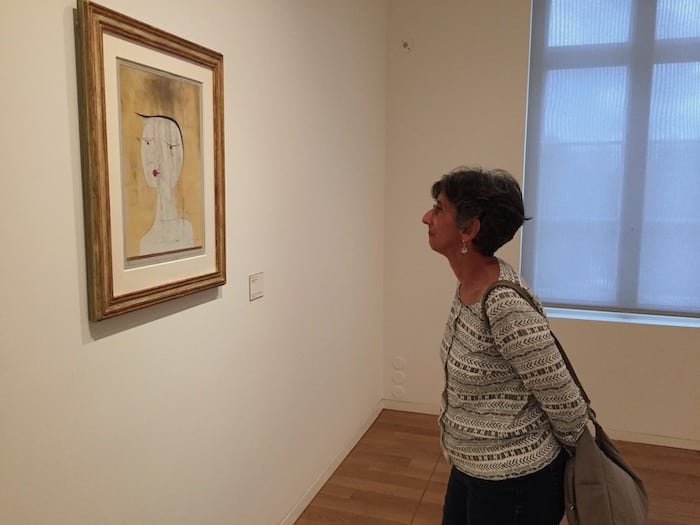
Image: Communing with Paul Klee at the Museum Berggruen in Berlin, 2018. Photo by Al.

Share this:

  • Share
  • Click to email a link to a friend (Opens in new window) Email
  • Click to print (Opens in new window) Print
  • Click to share on Facebook (Opens in new window) Facebook
  • Click to share on X (Opens in new window) X
  • Click to share on LinkedIn (Opens in new window) LinkedIn

Filed Under: Body, Hearing, Mind, Sight, Touch Tagged With: body-mind balance, hands, managing chronic disease, mindfulness, resilience

Small Miracles

Evelyn Herwitz · October 31, 2023 · Leave a Comment

For months, at least since March and maybe longer, I’ve had a charcoal-gray pit of calcium sticking in my left thumb. I have not been able to budge it or tease it out with tweezers. It has been lodged there, staring at me as I change my bandages morning and night. Sometimes it hurts, other times not. Sometimes it gets infected. Mostly it just serves as a reminder to handle things with care so I don’t bang it.

That is, until this weekend. I was doing my evening routine of cleaning my ulcers and re-bandaging them when I suddenly realized that the calcium pit was gone. No bigger than a poppy seed, it lay there on a piece of tissue. Really? I wondered, rolling it between thumb and forefinger, you were that small all this time?

More calcium hides beneath the surface in both of my thumbs. In x-rays, they look like long white chains from thumb tip to below the joint connecting thumb to palm. Slowly but inevitably, the pits work their way out of the skin. There’s nothing I can do to get rid of them but wait until they are ready to emerge, then wait until each one dislodges.

There is an obvious lesson about patience, here. I’ve learned to play along, not to aggravate the skin and nerves by jiggling the pit in a vain attempt at extraction. As long as I’m careful with how I cushion it with dressings and use Aquafor ointment to keep it moist (but not too moist) eventually, the calcium will exit on its own.

But there’s something else that fascinates. And that is how my body continually surprises me with its ability to heal, scleroderma or no scleroderma. It doesn’t always happen the way I want it to, or on a convenient timeline, but it does happen. That a calcium pit the size and color of a poppy seed can cause so much discomfort and then, one random evening, bid adieu, is one of the mysteries of this disease and the miracles of the healing process.

And so, until the next one appears, I will tend the hole in my thumb as it fills and be grateful for the reprieve.

Evelyn Herwitz blogs weekly about living fully with chronic disease, the inside of baseballs, turtles and frogs, J.S. Bach, the meaning of life and whatever else she happens to be thinking about at livingwithscleroderma.com. Please view Privacy Policy here.

Image: Victoria Tronina

Share this:

  • Share
  • Click to email a link to a friend (Opens in new window) Email
  • Click to print (Opens in new window) Print
  • Click to share on Facebook (Opens in new window) Facebook
  • Click to share on X (Opens in new window) X
  • Click to share on LinkedIn (Opens in new window) LinkedIn

Filed Under: Body, Mind, Sight, Touch Tagged With: calcinosis, finger ulcers, hands, managing chronic disease, resilience

The View from Black Mountain

Evelyn Herwitz · October 17, 2023 · 4 Comments

Eighty years ago, my mother graduated from Black Mountain College in North Carolina. She was one of the few students in this small, experimental college to actually graduate, though the fact that the institution was never accredited caused some issues when she began to apply for work beyond the home in the 1970s.

No matter. BMC was a unique, character-shaping environment that left a deep impression on all who studied and worked at its bucolic campus, beneath the beauty of the Blue Ridge Mountains, near Asheville. The college, which existed from 1933 to 1957, placed the arts at the core of its curriculum, with a particular focus on how a specific material or medium—paint, clay, fiber, paper, wood, concrete, photography, dance, music, poetry, and more—defines and informs the act of creating. The place was a hive of interdisciplinary cross-fertilization and produced a generation of extraordinary talents, taught by some of the most influential artists and thinkers of the 21st century.

My Mom, however, was not an artist. She was a psychology major. But she also helped to build BMC’s Lake Eden campus, its second home, as part of the school’s work collective. Collaboration was key to the BMC ethos, perfected in the work program. So was democratic governance by students and faculty. Among Mom’s fondest recollections of her three years at Black Mountain was learning carpentry, pipe-fitting, masonry, and electrical wiring to help build the Studies Building and the college’s farm buildings.

I was immersed in this inspring environment over the past weekend at a conference about Black Mountain, which I shared with our younger daughter. It was a fascinating deep dive into scholarship about BMC, its students and faculty and staff, its unique educational philosophy. We met some truly wonderful people who welcomed us into their circle with open arms. It was also a needed respite from the chaos gripping the world, even as grim headlines tap-tap-tapped on my mind throughout our stay.

Somehow, despite all its many financial struggles, BMC managed to flourish through the Great Depression and World War II as an avant-garde island in the Jim Crow South. The McCarthy era of Red-baiting, as well as changes in GI education funding, eventually spelled its demise. But the cultural and intellectual contributions, as well as the mythology of Black Mountain, live on. I will be processing what I’ve learned for a long time. Already, though, I feel the gravitational pull toward a BMC way of thinking and doing. All good.

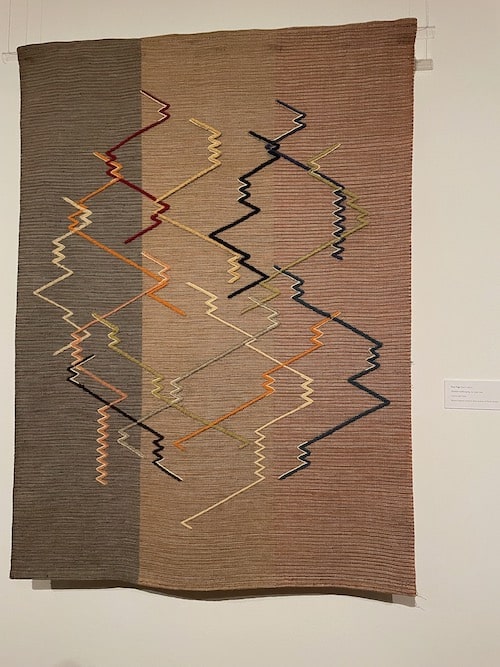
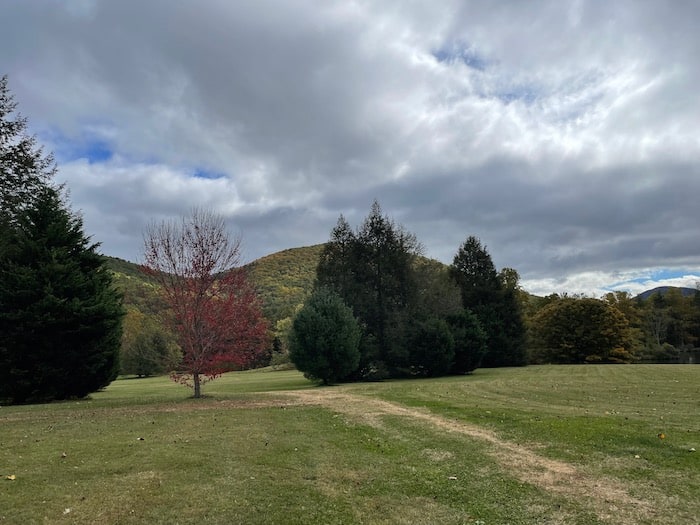
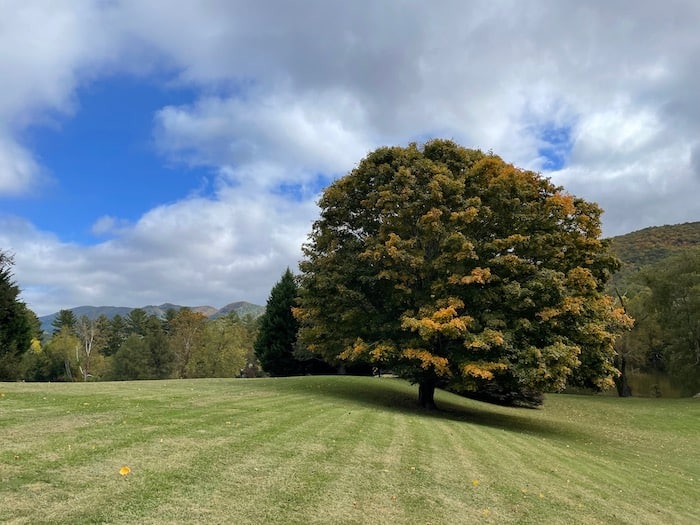
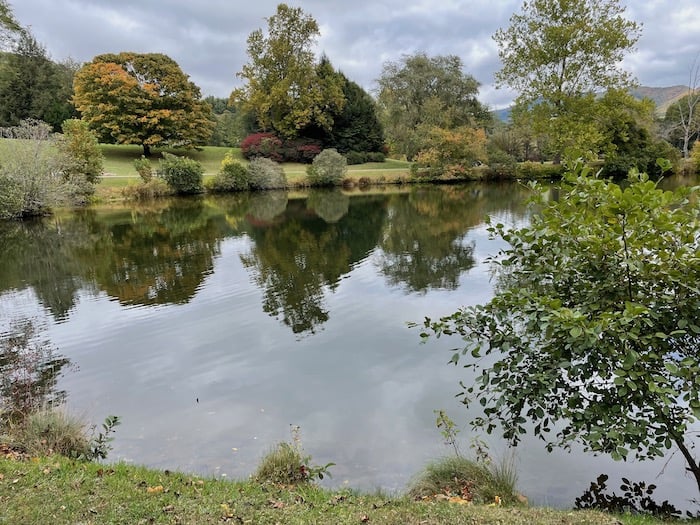
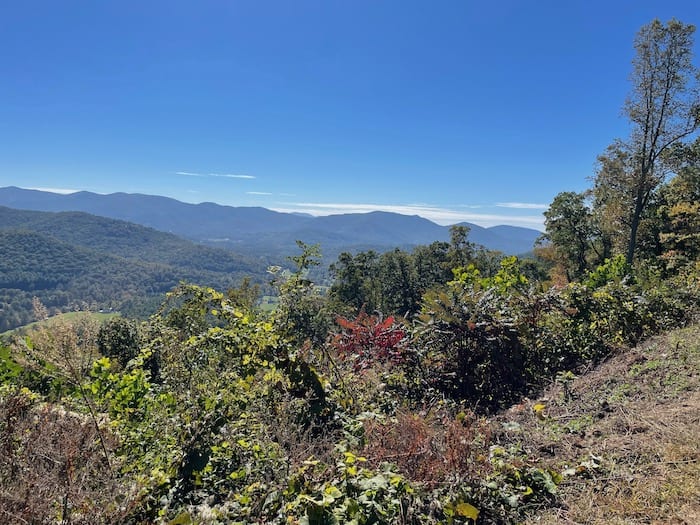
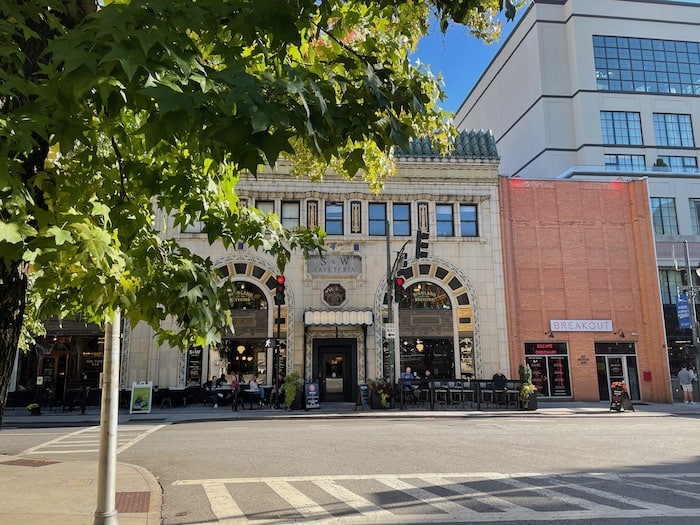
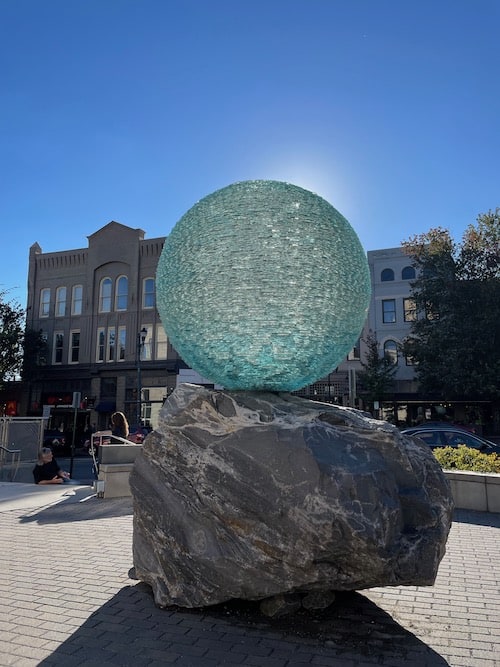
Here are some images of our visit to Asheville, the weaving exhibition at the heart of the conference, the former campus, and the stunning Blue Ridge Mountains. Enjoy, y’all.

Evelyn Herwitz blogs weekly about living fully with chronic disease, the inside of baseballs, turtles and frogs, J.S. Bach, the meaning of life and whatever else she happens to be thinking about at livingwithscleroderma.com. Please view Privacy Policy here.
Share this:

  • Share
  • Click to email a link to a friend (Opens in new window) Email
  • Click to print (Opens in new window) Print
  • Click to share on Facebook (Opens in new window) Facebook
  • Click to share on X (Opens in new window) X
  • Click to share on LinkedIn (Opens in new window) LinkedIn

Filed Under: Body, Hearing, Mind, Sight, Touch Tagged With: mindfulness, resilience, travel

Enter Fall

Evelyn Herwitz · September 19, 2023 · Leave a Comment

It is rainy and chilly and dreary as I write on Monday afternoon. Here in Central Massachusetts, we were fortunate to avoid the worst of Hurricane Lee over the weekend, and the rest of the week looks sunny. But I’m feeling the chill in my hands today, knowing that fall officially begins this Saturday.

Already, the days are notably shorter, the transition even more striking since we came back from the Baltics, where the sun sets later because it’s farther north.

And so, it’s time to make my annual adjustment, mentally and physically, to inevitable colder weather. I should be used to it by now, but I always hate to bid summer adieu. Time for lined leggings and sweaters and wrist-warmers, heavier coats and gloves and hats, more effort to get dressed and out the door.

Sigh.

At least there is fall foliage to look forward to. That, and crisp air, and fewer mosquitoes, and the way that autumn light etches shadows. Even as leaves begin to drop and trees harden off for winter, new buds are forming. My hands will adjust as I remind myself: Only three more months until the pendulum swings and the days grow longer, once again.

Evelyn Herwitz blogs weekly about living fully with chronic disease, the inside of baseballs, turtles and frogs, J.S. Bach, the meaning of life and whatever else she happens to be thinking about at livingwithscleroderma.com. Please view Privacy Policy here.
Share this:

  • Share
  • Click to email a link to a friend (Opens in new window) Email
  • Click to print (Opens in new window) Print
  • Click to share on Facebook (Opens in new window) Facebook
  • Click to share on X (Opens in new window) X
  • Click to share on LinkedIn (Opens in new window) LinkedIn

Filed Under: Body, Mind, Sight, Touch Tagged With: body-mind balance, finger ulcers, managing chronic disease, mindfulness, Raynaud's, resilience

Baltic Souvenir

Evelyn Herwitz · September 12, 2023 · 6 Comments

Last Wednesday, at midnight, Al and I returned from a two-and-a-half week trip to the Baltic states of Lithuania, Latvia and Estonia. I’m still processing all that we saw and heard and learned. It was a powerful journey that exceeded all our expectations. I planned a complex itinerary: fly to Helsinki, Finland, stay a couple of nights to recover from jet lag, then fly to Vilnius, explore for five days, go on to Riga for four days, then to Tallinn for another four days, catch the ferry back to Helsinki, and fly home the next day. And that is what we did.

We promised ourselves, in making this trip, to honor the memories of family who had perished in the Holocaust. Al was especially committed to commemorating his maternal grandmother’s brother, Avram Itzek, whom he believes was his namesake, and who chose not to leave his home town about an hour from Vilnius, in what is now Belarus, because it was where he felt he belonged. He was killed in the Holocaust. I hoped to uncover traces of my maternal grandfather’s Berlin cousins, who were deported to Riga in 1941 and perished there, though details of their fates are not known. We also hoped to learn more about the vibrant Jewish communities that once flourished in these countries and about what it meant to break free of the Soviet Union three decades ago—a historic moment made all the more poignant and relevant in light of the war in Ukraine.

Geopolitics made it impossible to visit Avram Itzek’s home town of Ashmyany—the day we landed in Helsinki, our embassy in Minsk told all Americans to leave Belarus because activity there by the Wagner Group, which has supported Russia’s invasion of Ukraine, made it too dangerous. The day we landed in Vilnius, Wagner leader Yevgeny Prigozhin’s plane fell out of the sky, undoubtedly retribution by Putin for his short-lived revolt against the Russian military back in June.

So, even a trip to the border for a glimpse in Ashmyany’s direction was out of the question. But as Al read more of the family history he’d brought along, he realized that before his grandmother’s family moved to Ashmyany, they had lived in the small village of Dieveniškes, located in the far southeast corner of Lithuania. With help from a friend, we traveled there on our last day in the country and found the Jewish cemetery where Al’s ancestors were laid to rest.

In Riga, we took a Jewish heritage tour with a private guide, and at the Museum of the Riga Ghetto and Holocaust in Latvia stood a long Wall of Remembrance with thousands of names. On the wall for Jews deported from Berlin in 1941, I found the name of my maternal grandfather’s first cousin, though not her husband, young son, or mother, who had all come with her. The Museum’s executive director, who sat with me to take all the family information that I had about these lost relatives, gave me a much needed hug and promised to research archives to find out what became of them all.

Not everything on our travels was heavy. A few fun facts: People in this part of the world are TALL. I thought it was my imagination, or a stereotype, but it’s true. In fact, in our Air BnB flat in Riga, I at first wondered why the closet hooks and hanger rod were up so high—then I realized, for tall people it was just right, especially because their longer clothes need more room to hang. Also, although ice hockey is the national sport of Latvia, both Latvians and Lithuanians are crazy about basketball. That, and chess. Everywhere we went, we saw chessboards, in libraries, in courtyards, in parks. And, everywhere we went, the food was outstanding.

The Old Town in Tallinn was the most beautiful of the three we stayed in, one of the best preserved medieval towns in Europe, still with its walls in tact. Much work is ongoing to preserve and restore buildings, many of which, here as in Riga and Vilnius, were destroyed in wars. One of the buildings in Old Town is painted a sugary pink. It is surrounded by metal crowd-control fencing, which is covered with posters protesting the war in Ukraine, as well as occupied lands in Georgia. This is the Russian Embassy in Estonia.

Throughout our travels, we saw Ukrainian flags flying in solidarity, Ukrainian blue and gold everywhere—from the Town Hall in Vilnius on our first night, illuminated as a rippling blue and gold flag on the eve of Ukraine’s Day of Independence anniversary, to an exhibit of new Ukrainian medals for bravery in battle at a museum of knighthood in Tallinn. These Baltic states, all about thirty years old as independent democracies, understand what it means to be conquered by Russia. Stories, of exile to Siberia under Stalin, of authoritarian rule, of always being under surveillance by the KGB, have not faded. And history is tragically repeating in neighboring Ukraine.

Whenever I travel abroad, to countries with much longer histories than these United States, I am reminded that world dominance ebbs and flows like the oceans that separate our continents. Authoritarian forces threaten democracies around the world and here at home. If history is any guide, we cannot take our own democracy’s survival for granted. I came home convinced, more than ever, that we must do all we can, especially this year, to preserve and protect free and independent, inclusive elections, so that the fate of our nation rests in the hands of the many, not of the few who would remake it in their own image.

So, that is what I’ve been thinking about as we traveled through the Baltics, and what I continue to wrestle with now that we’re back home. It was a journey that will stay with us for the rest of our lives. Here are just a few images from our trip . . .


Helsinki, Finland

In and Around Vilnius, Lithuania

In and Around Riga, Latvia

Tallinn, Estonia

Ferry to Helsinki

Evelyn Herwitz blogs weekly about living fully with chronic disease, the inside of baseballs, turtles and frogs, J.S. Bach, the meaning of life and whatever else she happens to be thinking about at livingwithscleroderma.com. Please view Privacy Policy here.
Share this:

  • Share
  • Click to email a link to a friend (Opens in new window) Email
  • Click to print (Opens in new window) Print
  • Click to share on Facebook (Opens in new window) Facebook
  • Click to share on X (Opens in new window) X
  • Click to share on LinkedIn (Opens in new window) LinkedIn

Filed Under: Body, Hearing, Mind, Sight, Smell, Taste, Touch Tagged With: resilience, travel, vacation

  • « Go to Previous Page
  • Page 1
  • Interim pages omitted …
  • Page 10
  • Page 11
  • Page 12
  • Page 13
  • Page 14
  • Interim pages omitted …
  • Page 97
  • Go to Next Page »

Primary Sidebar

Subscribe via Email

Enter your email address to subscribe to Living With Scleroderma and receive new posts by email. Subscriptions are free and I never share your address.

About the Writer

When not writing about living fully with chronic health challenges, Evelyn Herwitz helps her marketing clients tell great stories about their good works. She would love to win a MacArthur grant and write fiction all day. Read More…

Blog Archive

Recent Posts

  • What We Take for Granted
  • Self Pep Talk
  • Touch Type
  • Open Wider, Please
  • Long Drive for a Short Appointment

I am not a doctor . . .

. . . and don’t play one on TV. While I strive for accuracy based on my 40-plus years of living with scleroderma, none of what I write should be taken as medical advice for your specific condition.

Scleroderma manifests uniquely in each individual. Please seek expert medical care. You’ll find websites with links to medical professionals in Resources.

Copyright © 2025 · Daily Dish Pro on Genesis Framework · WordPress · Log in