• Mind
  • Body
  • Sight
  • Hearing
  • Smell
  • Taste
  • Touch
  • Skip to primary navigation
  • Skip to main content
  • Skip to primary sidebar

Living with Scleroderma

Reflections on the Messy Complexity of Chronicity

  • Home
  • About
    • Privacy Policy
  • What Is Scleroderma?
  • Resources
  • Show Search
Hide Search

anxiety

Chopin to the Rescue

Evelyn Herwitz · May 2, 2023 · 2 Comments

Last Thursday, I drove two hours in heavy traffic to Beth Israel Deaconess Medical Center in Boston to participate in a three-hour clinical study. As I wrote back in November, not long after I had a heart catheterization stress test, one of the cardiologists asked if I’d be willing to participate in a study to find a non-invasive alternative. I agreed, because the test was very unpleasant. If I could help to spare someone else that ordeal, I was willing.

So, after ignoring my GPS, which led me to the wrong side of the hospital, I finally found the parking garage and headed inside. (If you’ve ever been to the Longwood Avenue complex of medical centers in Boston, you’ll appreciate that this was no easy feat.) A pleasant research associate greeted me and reviewed the study protocol, which I had read in advance, so I knew, approximately, what I was in for: a six-minute walking test to establish my baseline, followed by an ECG, an IV insertion, a blood draw, then being hooked up again to an ECG for a 20 minute MRI, followed by up to 10 minutes peddling a recumbent bicycle, followed by a contrast dye infusion and another 30 minutes in the MRI. Not a cakewalk, but still better than the invasive procedure.

Now, I’m no fan of MRIs, which are loud and claustrophobic, and I was trying not to get anxious, anticipating THE BIKE. Last time I did this, I lasted three minutes before I felt really awful, because my pulmonary pressures skyrocketed. I was hoping that my new medication, more exercise in recent months, and better diaphragmatic breathing would all help.

So I really appreciated it when one of the researchers kindly asked if I’d like some music while in the MRI. I requested classical. “What kind of classical?” she asked. Really? You get a choice? I went for Chopin piano etudes, a favorite, and some of the most soothing music I could think of on the spot.

The walking test was easy. They set up two cones in a hallway of the research patients’ floor, and I kept a steady pace, back and forth, for the full six minutes with no issues. Ever the A student, I was pleased to know I was among the fastest walkers in the study, so far.

Then came the MRI. Lots of equipment to attach and adjustments to make as I lay on the bed that slides into the maw of that noisy monster. And, of course, it took two sticks to get a working IV in my arm, which is always the case. The final step was a set of earplugs to lessen the bangs and beeps, plus the headphones, and adjusting the volume so I could still hear Chopin. I hung onto every note of the beautiful melody as they slid me into the MRI and the study began.

The piano etudes were interrupted every few minutes by a recorded voice that instructed me when to breathe in, breathe out, then hold until I could breathe normally again. Beeeeep-bang-bang-bang-rumble-bang-bang-beep-beeeeep-bang. Ahh, Chopin.

I was glad when they rolled me out of the MRI, until the research tech told me that we weren’t done, yet, because the research software had crashed. Help was on the way. Fortunately, rebooting the computer solved the problem—and we were able to pick up where we left off. “Three million for the research software, but we’re still on a Microsoft platform,” he quipped.

Finally the first phase of MRI scans was completed and they rolled me out again, this time for THE BIKE. No headphones for this phase. I was on my own. I peddled up to the tempo they needed to boost my heart rate and made it through the first two minutes of resistance without a problem. “You’re like a metronome!” said the research tech. “Most people slow down and speed up.” “We aim to please,” I said, focusing on my breathing.

“On a scale of 1 to 10, how difficult is this?” asked another member of the team. I had trouble answering the question as she raised the resistance to the next level. “A 4?” I answered. Honestly, it was hard to assess while I was trying to manage my breathing. After about a minute at that resistance level, I began to feel some mild chest pressure, which I reported. I was able to finish another minute of peddling, and then they ended that part of the process. A good thing, because I could sense that I was going to start tanking soon.

Headphones back on, first dose of contrast dye infused, Chopin playing in my ears, I began to relax again—until the banging started up. At one point, there was some brrp-brrp-brrping that almost drowned out the music for what seemed like an eternity. I began to feel a bit claustrophobic, but at least could feel my legs outside the machine and even, sort-of, see them. The piano notes that I could catch were my buoy.

Finally, after a second infusion of dye and more banging and clanging, I was done. I felt a little shaky when I sat up, with help, but was soon able to walk back to the changing room and get dressed. They got the data they needed, and I survived without that awful shortness-of-breath feeling. I did my bit for medical science, and, I hope, for someone else down the line who can avoid having a mask with a breathing tub clamped to their face and a heart catheter threaded down their neck while peddling THE BIKE.

On my way out of the hospital, I rewarded myself with a glazed doughnut for the drive home. And just as I got back on the Mass Pike, what should be playing on my Sirius XM station? Chopin, of course.

Evelyn Herwitz blogs weekly about living fully with chronic disease, the inside of baseballs, turtles and frogs, J.S. Bach, the meaning of life and whatever else she happens to be thinking about at livingwithscleroderma.com. Please view Privacy Policy here.

Image: Accuray
Share this:

  • Share
  • Email a link to a friend (Opens in new window) Email
  • Print (Opens in new window) Print
  • Share on Facebook (Opens in new window) Facebook
  • Share on X (Opens in new window) X
  • Share on LinkedIn (Opens in new window) LinkedIn

Filed Under: Body, Hearing, Mind, Sight, Touch Tagged With: anxiety, managing chronic disease, mindfulness, pulmonary hypertension, resilience, scleroderma research

Auf Wiedersehen

Evelyn Herwitz · March 28, 2023 · 8 Comments

And so, I made the trip to Germany. On my own, abroad, for the first time in my life. It was an extraordinary, transformative experience, not only for all that I saw and learned, and all the people I met along the way, but also for rediscovering that fearless explorer within, who has been hiding for decades since I first heard the word scleroderma.

As I’ve written here in recent months, the past couple of years with this disease have been more complicated. Finding myself suddenly short of breath when physically or emotionally stressed led to a battery of diagnostic exams, and ultimately a diagnosis of Type 2 Pulmonary Hypertension. Thanks to my wonderful cardiologist, I found a calcium channel blocker that works for me and mitigates the worst of the symptoms. I’ve also learned some new breathing techniques that help to avoid the problem when I start feeling stressed.

With all that, as I began to feel better again and moved past the worst of the pandemic, I felt a great need to get out—get out of my head, get out of my routine, and get out of the country to travel once more. I needed to prove to myself that I could do this on my own. Working on a novel about Germany during the Weimar Era and rise of the Third Reich, I had to see what I’d only been able to read about, and I needed to focus. I have family roots in Germany, as well. My mother and her parents immigrated to the U.S. in 1936 to escape the Nazis. So the visit was multi-layered.

As is always the case with travel, not everything went as planned. On both ends of my trip, I had to make last minute changes in my transatlantic flight—pushing back my departure from Boston by two days to avoid a Nor’easter that was threatening to wreak havoc with snow and high winds, and leaving a day early at the end when my flight home from Munich was cancelled due to a planned airport strike. (Yes, they plan strikes there, so you can work around it.) There were also two instances when the S-Bahn (commuter rail) in Berlin was running late or disfunctional, and I had to figure out how to grab a taxi to get to a tour on time. But it all worked out. And, to my amazement, I just rolled with it and problem-solved along the way.

For the most part, however, the trip was a wonderful journey, beginning with my seat mate on the way over, who was from Munich and gave me excellent suggestions for my two-night layover there. From Munich I flew to Berlin, where I stayed five nights in the very funky Hotel-Pension Funk, the former home of a silent film star that is decorated in period Art Nouveau style. I immersed in history, art, design, and architecture, including a visit to the Museum der Dinge (Museum of Things), where I learned about design standards as the country shifted from handcrafts to industrial manufacturing, and an outstanding private tour of sites and stories about Weimer Berlin. I also had dinner one evening with good friends and spent a day touring with them, as well.

From Berlin I traveled by train to Dessau, just under two hours southwest of Berlin, to stay at the Bauhaus, now a UNESCO World Heritage site. The Bauhaus School was in existence from 1919-1933, first in Weimar, then in Dessau, and finally for a brief period in Berlin before it closed under Nazi pressure. Founded by architect Walter Gropius, the Bauhaus melded art and technology to rethink how people could live and work humanely and cooperatively in post WWI society. I stayed two nights in what had been student housing, and toured the building as well as the outstanding Bauhaus Museum in the city.

From Dessau, I took a high speed train back to Munich, where I stayed at a small, very comfortable modern hotel in the Altstadt (Old City). My time in Munich at the beginning and end of the trip focused on why and how the Nazis formed there and gained power under Hitler. In both Berlin and Munich, I also visited concentration camp memorials—Sachsenhausen outside of Berlin and Dachau outside of Munich. Both tours were powerful experiences, sobering, profoundly thought-provoking. There is much dark history in Germany, but also a deep public reckoning with the past.

In Berlin, on Shabbat, I went to a synagogue that was a short walk from my hotel. The Pestalozzi synagogue was burned on November 9, 1938, on what has been called Kristallnacht, the Night of the Broken Glass, but is now referred to in Germany as the Reichspogrom—a more accurate description of the two nights when Nazis directed the destruction of synagogues and Jewish-owned businesses in pogroms throughout the country. Pestalozzi was not totally destroyed (burning it risked a neighborhood that the Nazis wanted to save) and was restored and rededicated after the war in 1947. It is a beautiful building, and the service felt much like ours at home.

Later, I realized that I was the first member of my family to set foot in a Jewish house of worship in Berlin in a century. It was one of the most important moments of the trip. I am still processing all that I experienced, and will be for some time. I am glad to be home, but I was also sad to leave. Most of all, I’m grateful to my dear Al, our wonderful daughters, many friends, and my entire medical team, who fully supported me on this adventure, and for the fact that I was able to thrive on my own.

Here are just a few images from my travels.

Nymphenburg Palace in Munich, where I walked the grounds to stay awake after my transatlantic flight.


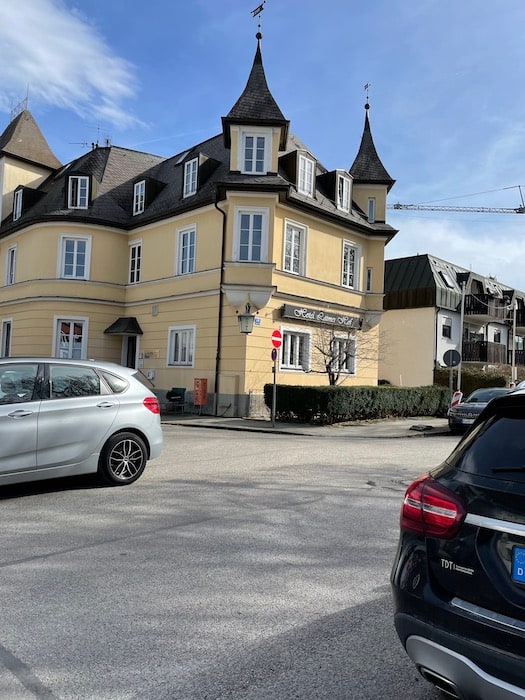
Hotel Laimer Hof, my accommodations in Munich at the beginning of the trip


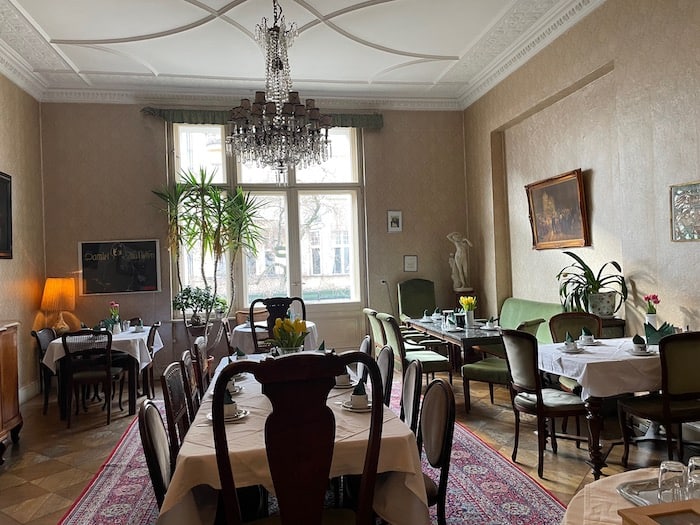
The breakfast room at the Hotel-Pension Funk in Berlin


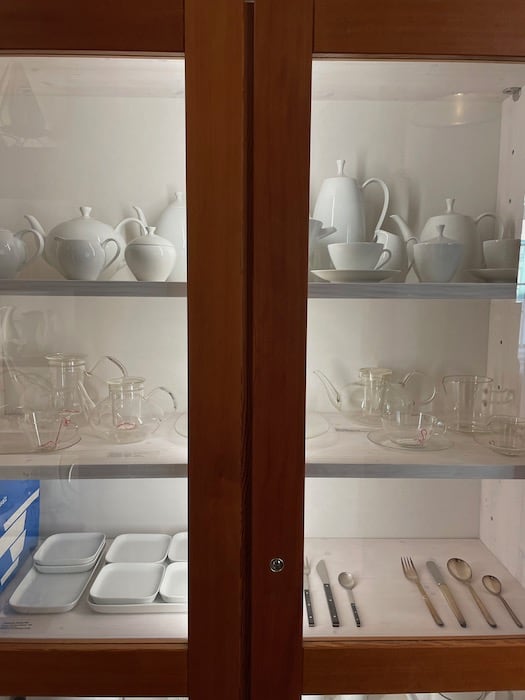
Dishes and utensils at the Museum der Dinge, which reminded me of my grandmother’s china and flatware


TV sets at the Museum der Dinge


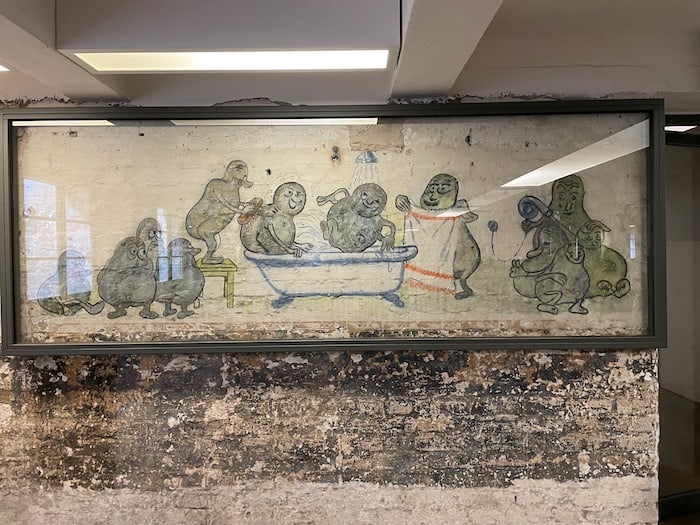
Starving Sachsenhausen prisoners drew this on the walls of the camp kitchen’s potato peeling cellar.


Berliner Ensemble, formerly the Theater am Schiffbauerdamm, where Bertolt Brecht’s and Kurt Weill’s Threepenny Opera debuted.


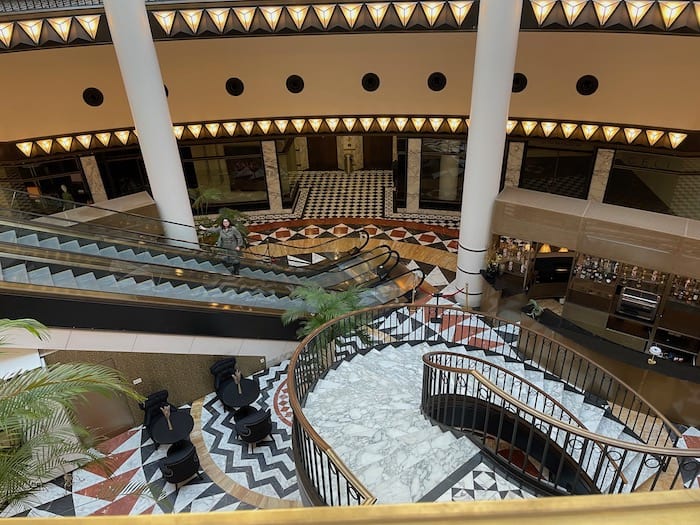
Inside Friedrichstadtpassagen shopping center, former site of two famous clubs, the Weisse Maus and Cabaret of the Nameless


Theater des Westens. The basement housed the Tingel-Tangel Cabaret, which performed biting satire of the Nazis even for a few months after Hitler became Chancellor in 1933.


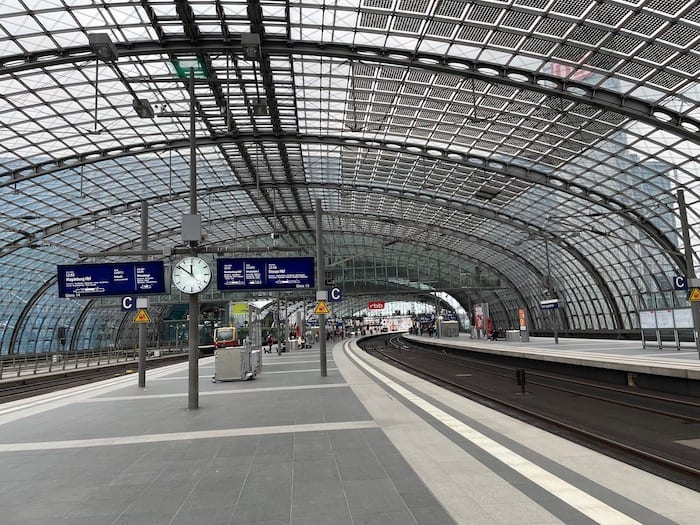
At the Berlin Hauptbahnhof, waiting for my train to Dessau


The Bauhaus in Dessau, view of the Studio Building where I stayed


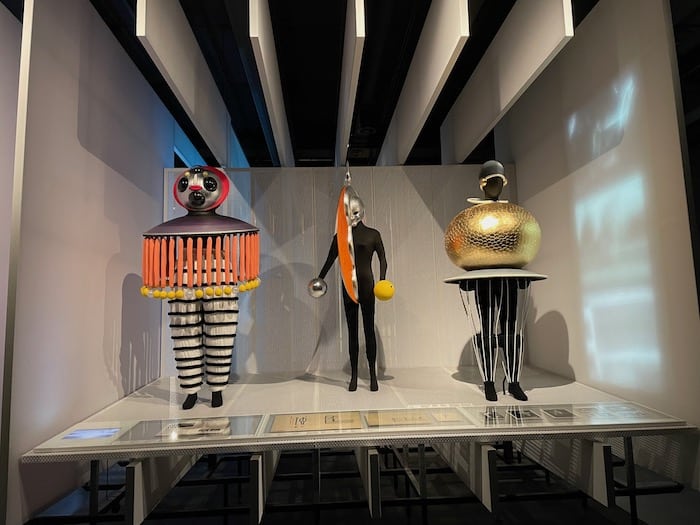
Costumes for a Bauhaus dance performance, at the Bauhaus Museum in Dessau


Weaving at the Bauhaus Museum by Gunta Stöltz (1928), rewoven/restored by Katharina Jebson (2022)


Student notes from a Bauhaus class with Paul Klee, Bauhaus Museum


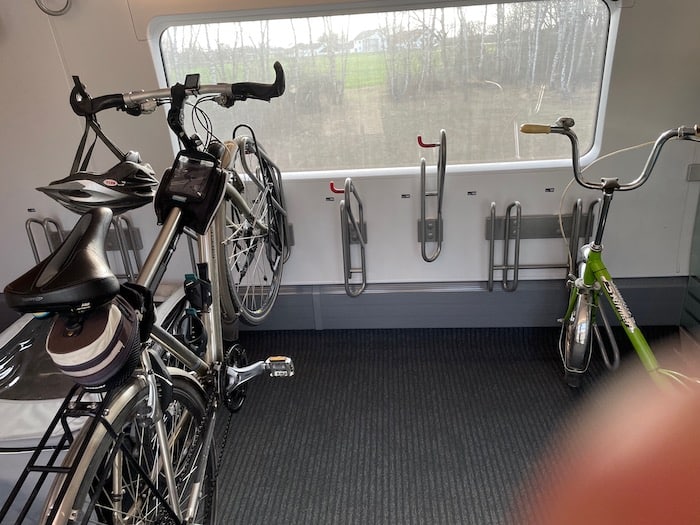
Bike rack on the high speed ICE train to Munich


The Neues Rathaus (New Town Hall) in Munich


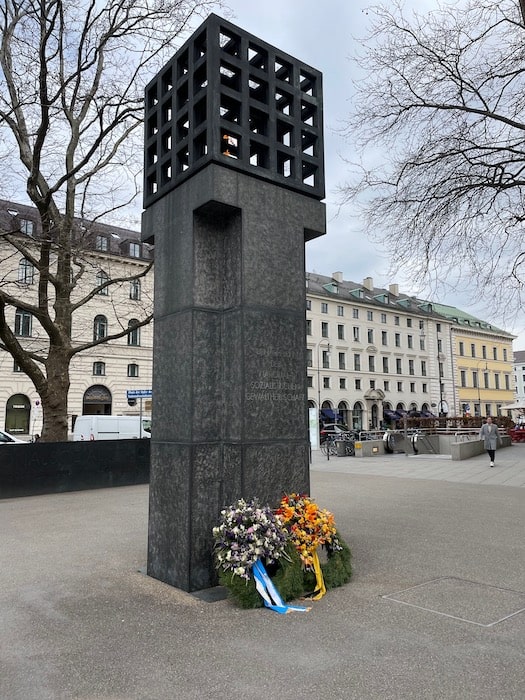
Munich memorial to victims of the Nazis


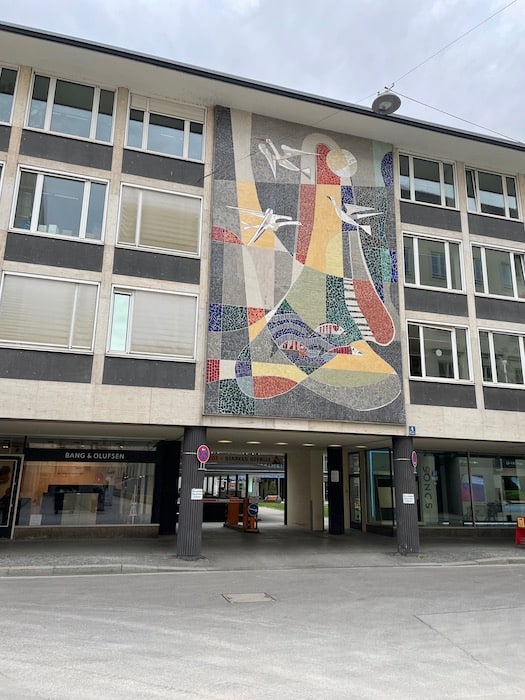
Public mural in Munich


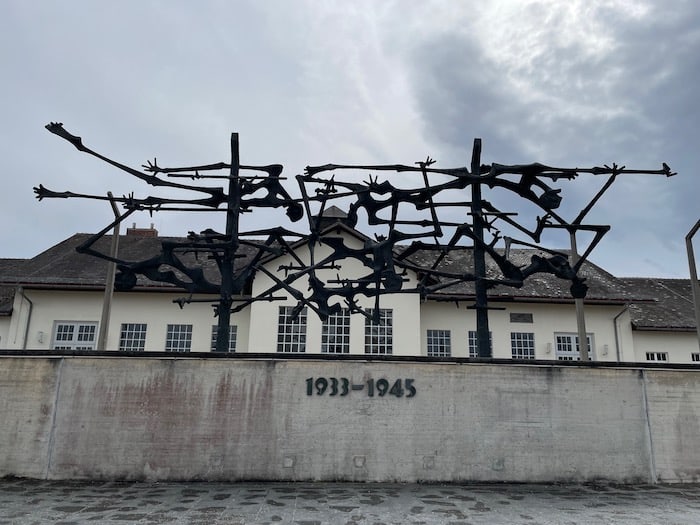
Memorial to prisoners at Dachau Concentration Camp Memorial Site


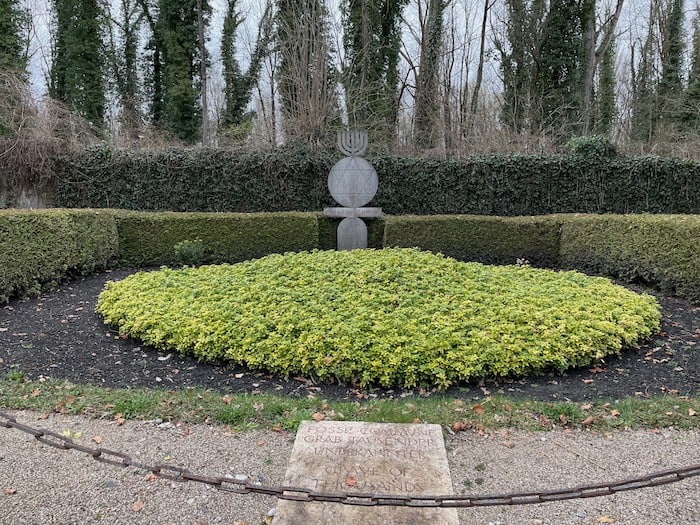
Commemorating those who died at Dachau

Evelyn Herwitz blogs weekly about living fully with chronic disease, the inside of baseballs, turtles and frogs, J.S. Bach, the meaning of life and whatever else she happens to be thinking about at livingwithscleroderma.com. Please view Privacy Policy here.

Share this:

  • Share
  • Email a link to a friend (Opens in new window) Email
  • Print (Opens in new window) Print
  • Share on Facebook (Opens in new window) Facebook
  • Share on X (Opens in new window) X
  • Share on LinkedIn (Opens in new window) LinkedIn

Filed Under: Body, Hearing, Mind, Sight, Smell, Taste, Touch Tagged With: anxiety, managing chronic disease, pulmonary hypertension, resilience, vacation

#24

Evelyn Herwitz · August 3, 2021 · 4 Comments

More than two years have passed since I last had a tooth extracted due to a complication of scleroderma that causes my immune system to attack the roots of my teeth. But, once again, another one had to go. This time, it was my lower front left tooth, known to dentists as #24.

I’ve had two implants so far. My dental team and I have been tracking another four teeth at risk. At my last cleaning, my hygienist noticed that 24 looked pink at the bottom, indicating the tooth was hollowing out and blood was seeping inside. An X-ray confirmed the extent of the resorption.

At that point, surprisingly, I was not experiencing any nerve pain, given the damage. A consult with my periodontist left timing of the inevitable procedure up to me. I also saw my dentist to discuss the situation, have a new panorama X-ray taken, and figure out where things stood. The other three teeth have not progressed as far, fortunately, so I’ll just continue to deal with them one at a time. But after about a month, I realized 24 was getting more sensitive. I heal faster in summer, so it was time to take care of it.

And so it was, last Wednesday, that I found myself, once again, slightly upside down in my periodontist’s exam chair, trying not to get anxious as I awaited the first shot of Novocaine. Fortunately, the topical anesthetic that preceded the shots worked expeditiously, and the Novocaine took hold quickly, too, so I was spared much discomfort. But I still hate those needles.

Since the tooth was up front, the procedure was somewhat easier than for the past two molars. Just one root instead of multiples, and no overstretching my mouth to get in the back, which is very uncomfortable. But as has been the case before, the ligaments that form a sock around the roots, making it easier to pull, were dried up, so the root was fused to my jaw and had to be drilled out.

The whole process took about an hour, half the time for previous molars. I did my best to stay in the moment, breathe, and listen to Vivaldi streaming on the music system. I recognized one of the pieces that I used to play on my violin in high school. It was a relief when my periodontist finished the last stitch and I could get out of that chair.

Residual pain, once the Novocaine wore off, was, thankfully, minimal and manageable with over-the-counter pain meds. Swelling subsided within 48 hours, thanks to a lot of icing that first day. I can eat without much trouble.

The one mistake I made was assuming the missing tooth, given that is was in my lower jaw, would not be noticeable. Alas, I look like Alfred E. Neuman, except on the bottom. So, I’m going to have a “flipper” made, which is a false tooth that is removed when you eat. Given that this whole procedure, from extraction to implant to crown, will cost about $9,000, with no insurance coverage (outrageous!), the additional $350 for the flipper seemed a drop in the bucket. I really don’t want to live with a gap in my teeth for nine months until I get the crown. I’m not letting scleroderma get the better of how I look and feel about my appearance. Some might call it vanity, but I call it self-esteem.

And there’s a silver lining. Once again, by charging payments on my travel credit card, which we always pay off at month’s end, I’ll at least get more points for whenever we can finally take another extended vacation safely, without fear of Covid complications. Hoping that’ll be at least by next April, when 24 is fully replaced.

Sooner would be better.

Evelyn Herwitz blogs weekly about living fully with chronic disease, the inside of baseballs, turtles and frogs, J.S. Bach, the meaning of life and whatever else she happens to be thinking about at livingwithscleroderma.com. Please view Privacy Policy here.

Image: Photo courtesy of Gratisography

Share this:

  • Share
  • Email a link to a friend (Opens in new window) Email
  • Print (Opens in new window) Print
  • Share on Facebook (Opens in new window) Facebook
  • Share on X (Opens in new window) X
  • Share on LinkedIn (Opens in new window) LinkedIn

Filed Under: Body, Mind, Taste, Touch Tagged With: anxiety, body-mind balance, managing chronic disease, tooth implant, tooth resorption, vacation

Tick-Tock

Evelyn Herwitz · February 9, 2021 · 1 Comment

Today’s announcement: I have entered the world of wearable health tech. This was not planned. In fact, it’s something I’ve avoided, because I didn’t want to obsess about how many steps I’ve taken each day. However, I learned some things from my heart study that made this a priority. So I am now wearing my new Apple Watch, which has already proven its worth.

Back in December and early January, as I’ve written previously, I did a three-week Holter monitor study, because my arrhythmia had been very active in recent months. And, as expected, the study validated my observations, fortunately with the reassuring news that my annoying arrhythmia is still within the normal range of abnormal, as it has been for decades. A nuisance, more than anything.

However, the study also recorded a more concerning development, one 15-second episode of a Type 2 Heart Block. There are two types of Type 2 Heart Blocks, and true to form, mine was the more complicated, which involves a blockage of certain electrical signals so they don’t transmit properly and the heart slows down. In my case, I had no symptoms of my heart rate slowing, because one part of my heart doubled the number of electrical signals it was sending, but only half of those transmitted, so the result was my normal heart rate.

This was rather disturbing news. I’ve known for years that scleroderma can cause changes to heart tissue over time. I had a long discussion with my cardiologist about this several weeks ago, and we agreed that I needed some way to keep monitoring my heart in case I do experience episodes of sudden light-headedness or dizziness going forward. This has happened to me on occasion over the years, but even though I felt weird, it was so infrequent that I just let it pass. The options were: (a) a mini portable ECG monitor that I could use to record readings and then email reports to him; (b) an Apple Watch, which has an ECG app that I could use to do the same; or (c) a small chest implant that would monitor my heart for three years.

The implant was a non-starter. The mini portable ECG was the most affordable, but a nuisance to carry with me all the time. So, I went for the watch. Fortunately, I could afford it. Not cheap, but a powerful little computer to wear on your wrist with many useful features.

I put the system to the test recently, when I got quite stressed one Friday evening when I was trying to reach Al and could not get hold of him (it all worked out, but it was one of those days). My arrhythmia kicked up big time, so after Al got home and all was well again, I took several ECG readings on my new watch. I picked the first and the last when I felt back to normal, and emailed the PDFs from my iPhone to my cardiologist with a note. Within a half hour, he wrote me back that these were the “okay” kind of extra beats, so no problem, but to keep him posted. We’re catching up again this Friday.

This was very reassuring. I’ve had no cause to send any more ECGs since then, but I am now learning to use my watch to track exercise. It’s always been clear to me that my heart feels better when I walk, but I’ve been avoiding it because of the cold weather. Now, however, I have a big incentive to get moving. And I have a very cool way to keep track of steps, exercise, calories burned, and general movement. Already, I’ve pushed myself out the door for walks that I wouldn’t have taken before all of this. I’ve tried out a fitness routine. And I do feel a little better for it all, so far.

It’s been a month of coming to terms, or, at least, beginning to come to terms with the fact that this very ornery disease still has some curve balls to throw at me. I have lived with scleroderma for nearly 40 years, now. I’ve been fortunate that my disease has always moved slowly enough for me to learn how to compensate. With the help of some amazing tech and a wonderful cardiologist, I intend to continue doing just that.

Evelyn Herwitz blogs weekly about living fully with chronic disease, the inside of baseballs, turtles and frogs, J.S. Bach, the meaning of life and whatever else she happens to be thinking about at livingwithscleroderma.com. Please view Privacy Policy here.

Share this:

  • Share
  • Email a link to a friend (Opens in new window) Email
  • Print (Opens in new window) Print
  • Share on Facebook (Opens in new window) Facebook
  • Share on X (Opens in new window) X
  • Share on LinkedIn (Opens in new window) LinkedIn

Filed Under: Body, Mind, Touch Tagged With: anxiety, Apple Watch, arrhythmia, body-mind balance, managing chronic disease, resilience

Ever Since

Evelyn Herwitz · January 12, 2021 · 2 Comments

Last Thursday afternoon I got a call from my cardiologist’s nurse. She was checking in on how I was doing with my heart study, if I’d had any issues or symptoms. So I told her that the monitor had collected plenty of data, given that my arrhythmia had been quite active at various points over recent weeks.

Especially on Wednesday, during the violent siege on our nation’s Capitol. Watching the rioters, I was horrified. I thought of my mother, now long gone, who was 10 years old in Berlin during the Reichstag Fire in February 1933 that cemented the Nazi’s rise to power.

“They’re saying it was Antifa,” the nurse told me, in a confidential tone. She began to recount the latest distortions of what we had all witnessed on live television the day before, rioters breaking into the Capitol beneath fluttering Trump banners and the Confederate flag. I tried to stop her, but she went on enthusiastically for a few minutes.

Finally, I interrupted. “No,” I said, “it was not Anitfa, it was Trump supporters who stormed the Capitol, but I don’t want to get into an argument with you about it.”

She deftly switched back to my heart study and said she would put my cardiologist on the line. I did not mention to him what she said.

But I have been thinking about it ever since.

This woman is a person with empathy. She spoke to me very kindly about my symptoms. I’m sure she’s a fine nurse. She was also spouting very dangerous rhetoric, which she clearly believes.

Words matter. Lies repeated, amplified, matter. Facts, evidence, truth, critical thinking—all matter.

So does our ability to see the humanity in each and every one of us.

I am praying for our country, for our president-elect and vice president-elect, and for a peaceful transition of power on January 20. I am praying that the maelstrom of lying and distortions will finally, finally, spin itself dry. I am praying that we can truly hear one another, seek common ground, and collaborate for the common good to solve the enormous problems facing us and the world.

After one of the darkest days in our nation’s history, let there be light.

Evelyn Herwitz blogs weekly about living fully with chronic disease, the inside of baseballs, turtles and frogs, J.S. Bach, the meaning of life and whatever else she happens to be thinking about at livingwithscleroderma.com. Please view Privacy Policy here.

Image: Andy Feliciotti

Share this:

  • Share
  • Email a link to a friend (Opens in new window) Email
  • Print (Opens in new window) Print
  • Share on Facebook (Opens in new window) Facebook
  • Share on X (Opens in new window) X
  • Share on LinkedIn (Opens in new window) LinkedIn

Filed Under: Body, Hearing, Mind, Sight, Touch Tagged With: anxiety, arrhythmia, managing chronic disease, resilience

  • « Go to Previous Page
  • Page 1
  • Page 2
  • Page 3
  • Page 4
  • Page 5
  • Page 6
  • Interim pages omitted …
  • Page 8
  • Go to Next Page »

Primary Sidebar

Subscribe via Email

Enter your email address to subscribe to Living With Scleroderma and receive new posts by email. Subscriptions are free and I never share your address.

About the Writer

When not writing about living fully with chronic health challenges, Evelyn Herwitz helps her marketing clients tell great stories about their good works. She would love to win a MacArthur grant and write fiction all day. Read More…

Blog Archive

Recent Posts

  • Here We Go Again
  • Until Next Year
  • And Now for Something Completely Different
  • 700-plus
  • It’s Never Simple

I am not a doctor . . .

. . . and don’t play one on TV. While I strive for accuracy based on my 40-plus years of living with scleroderma, none of what I write should be taken as medical advice for your specific condition.

Scleroderma manifests uniquely in each individual. Please seek expert medical care. You’ll find websites with links to medical professionals in Resources.

Copyright © 2026 · Daily Dish Pro on Genesis Framework · WordPress · Log in