• Mind
  • Body
  • Sight
  • Hearing
  • Smell
  • Taste
  • Touch
  • Skip to primary navigation
  • Skip to main content
  • Skip to primary sidebar

Living with Scleroderma

Reflections on the Messy Complexity of Chronicity

  • Home
  • About
    • Privacy Policy
  • What Is Scleroderma?
  • Resources
  • Show Search
Hide Search

hands

The Power of Art to Heal

Evelyn Herwitz · November 21, 2023 · Leave a Comment

It’s been one of those stretches when all of my medical appointments jammed together. Since last Thursday, I’ve had one tele-med plus two in-person appointments at Boston Medical. Thank goodness for remote visits, or I would have had to drive into Boston to the same place on three different days instead of “just” two.

Even so, I am grateful for the excellent medical care I receive. I was reminded of this all the more while recently watching a new documentary, Angel Applicant, by filmmaker Ken August Meyer.

Meyer lives with diffuse scleroderma, the most aggressive form, and he tells of how he found comfort and insight into his experience from the art of Paul Klee, who died of complications from the disease in 1940, seven years after being exiled from Nazi Germany to Bern, Switzerland. Klee is a favorite of mine, too, for his luminous paintings, as well as for my sense of kinship with him as an artist who created some of his best works during the three years that he wrestled with systemic sclerosis.

Meyer’s film is the most meaningful, poignant, and true story of what it means to live with scleroderma that I have yet encountered. Though it is not in wide distribution, it won multiple awards this year and is currently available to stream on DOC NYC for $15, through November 26. I recommend it highly. You can find the link information here.

I must add that it was not easy for me to watch. Meyer’s experiences, though more debilitating than my own, resonated deeply. Everyone’s encounter with scleroderma is unique, and his has been brutal. Even as I have been living with my own version of this inscrutible disease for more than four decades, now, I gained a different sense of what I’ve been up against all these years that really shook me. At the same time, I profoundly appreciated how he has come to terms with all that scleroderma has thrown at him through his exploration of Klee’s exquisite art. We each have to find our own path in dealing with chronic illness. Meyer’s journey is inspiring.

Above all, the love of Meyer’s family and friends has been essential to his ability to persist through life-threatening challenges. I feel equally blessed.

To you and yours, Dear Reader, my best wishes for a healthy and happy Thanksgiving. Be well.

Evelyn Herwitz blogs weekly about living fully with chronic disease, the inside of baseballs, turtles and frogs, J.S. Bach, the meaning of life and whatever else she happens to be thinking about at livingwithscleroderma.com. Please view Privacy Policy here.

Image: Communing with Paul Klee at the Museum Berggruen in Berlin, 2018. Photo by Al.

Share this:

  • Share
  • Email a link to a friend (Opens in new window) Email
  • Print (Opens in new window) Print
  • Share on Facebook (Opens in new window) Facebook
  • Share on X (Opens in new window) X
  • Share on LinkedIn (Opens in new window) LinkedIn

Filed Under: Body, Hearing, Mind, Sight, Touch Tagged With: body-mind balance, hands, managing chronic disease, mindfulness, resilience

Small Miracles

Evelyn Herwitz · October 31, 2023 · Leave a Comment

For months, at least since March and maybe longer, I’ve had a charcoal-gray pit of calcium sticking in my left thumb. I have not been able to budge it or tease it out with tweezers. It has been lodged there, staring at me as I change my bandages morning and night. Sometimes it hurts, other times not. Sometimes it gets infected. Mostly it just serves as a reminder to handle things with care so I don’t bang it.

That is, until this weekend. I was doing my evening routine of cleaning my ulcers and re-bandaging them when I suddenly realized that the calcium pit was gone. No bigger than a poppy seed, it lay there on a piece of tissue. Really? I wondered, rolling it between thumb and forefinger, you were that small all this time?

More calcium hides beneath the surface in both of my thumbs. In x-rays, they look like long white chains from thumb tip to below the joint connecting thumb to palm. Slowly but inevitably, the pits work their way out of the skin. There’s nothing I can do to get rid of them but wait until they are ready to emerge, then wait until each one dislodges.

There is an obvious lesson about patience, here. I’ve learned to play along, not to aggravate the skin and nerves by jiggling the pit in a vain attempt at extraction. As long as I’m careful with how I cushion it with dressings and use Aquafor ointment to keep it moist (but not too moist) eventually, the calcium will exit on its own.

But there’s something else that fascinates. And that is how my body continually surprises me with its ability to heal, scleroderma or no scleroderma. It doesn’t always happen the way I want it to, or on a convenient timeline, but it does happen. That a calcium pit the size and color of a poppy seed can cause so much discomfort and then, one random evening, bid adieu, is one of the mysteries of this disease and the miracles of the healing process.

And so, until the next one appears, I will tend the hole in my thumb as it fills and be grateful for the reprieve.

Evelyn Herwitz blogs weekly about living fully with chronic disease, the inside of baseballs, turtles and frogs, J.S. Bach, the meaning of life and whatever else she happens to be thinking about at livingwithscleroderma.com. Please view Privacy Policy here.
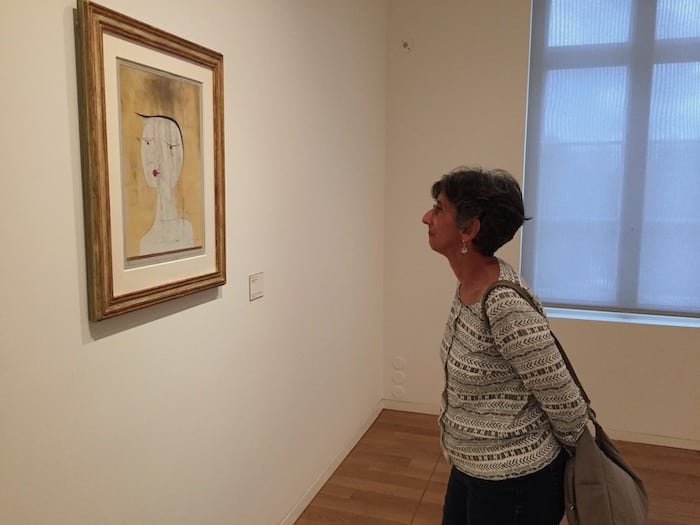
Image: Victoria Tronina

Share this:

  • Share
  • Email a link to a friend (Opens in new window) Email
  • Print (Opens in new window) Print
  • Share on Facebook (Opens in new window) Facebook
  • Share on X (Opens in new window) X
  • Share on LinkedIn (Opens in new window) LinkedIn

Filed Under: Body, Mind, Sight, Touch Tagged With: calcinosis, finger ulcers, hands, managing chronic disease, resilience

Rhapsody in Teal

Evelyn Herwitz · August 8, 2023 · 8 Comments

I haven’t sewn a garment for myself in quite a while, not since December 2021, to be precise. That project was an alpaca wool jacket, which came out fine, but I haven’t worn it too often because the fabric is a bit itchy. Oh, well. One of the challenges of making your own clothes is learning to pick the right fabric for the right project.

I have a lot of fabric in my stash, accumulated over decades. This is a common challenge for people who enjoy sewing—inspiration and purchase, followed by lack of time, energy, or whatever excuse to actually sew the garment. Call me guilty, as charged. But recently, I decided that if I wasn’t going to sew something or make use of all those fabric scraps from prior projects, I should at least find a way to responsibly recycle them.

Turns out our composting service will recycle textiles for a minimal fee. So I dug through my fabric stash to see what to eliminate. Not easy. I have a lot of nice textiles. Still, it was time to be realistic. After filling a bag for recycling with scraps that I will never use, I examined several yards of beautiful teal rayon. I must have purchased it not long after Al and I married, so it’s nearly 40 years old. But still in excellent condition.

Then I dug through old patterns, many of which I will never sew because I no longer like the styles, and bagged a bunch to recycle. But I found one, a simple caftan, that held promise for that gorgeous fabric.

Rayon is a tricky fiber. It drapes beautifully, but ravels easily and is slippery to sew. With two thumbs in bandages at present and limited dexterity, I knew it would be a challenge. That’s probably why I’ve avoided it all these years.

I read up on sewing techniques for rayon and set to. First I zigzagged the ends to prevent raveling, washed the rayon on delicate to pre-shrink, then air-dried it and pressed it on low (no steam). After testing the pattern with left-over muslin for the front and gingham for the back (more leftovers), I made some adjustments. Then I went to the fabric store and bought a better rotary blade cutter than my old ones, which I could no longer hold properly, some rayon thread, and some extra sharp needles for my sewing machine (recommended for rayon).

The rotary cutter was worth it, because I was able to cut out the pattern quickly and neatly, without hurting my hand. Theoretically, you’re not supposed to use pins other than those intended for silk, or they’ll leave permanent holes in rayon. I tried mini binder clips to hold the seams when I stitched, but they were too clunky and hard to open and place properly. Turns out, fortunately, that this fabric was fine with pins.

I took my time. I experimented with seam binding, but that didn’t work. I couldn’t serge the seams, because the serger destroyed the delicate fabric. So I stitched the seams on my trusty old Huskvarna, trimming them and zig-zagging the edges. For the neckline binding, I had enough fabric to cut bias strips, found some stretchy iron-0n interfacing in my stash, and made custom bias tape, which worked great.

Finishing the sleeves and hem was the hardest part of the project, because the pattern called for pressing under a quarter-inch of the edge, then folding it again and stitching down. Like I said, the fabric is slippery and I don’t have the ability to nudge a narrow, raw edge with my fingertips, which no longer exist. Stitching a quarter inch from the fabric’s raw edge gave me a guide for the first fold, which I pressed. Then I made the second fold, pinned and lightly pressed. But the big aha was realizing I could top-stitch the hem from the wrong side, thus easily controlling the narrow folded edge, and no-one would know the difference.

The finished dress earned a “Wow!” from Al, the desired response. I’m really pleased with it. It’s cool and comfy and fun to wear. All these years later, I finally found the right project for that beautiful teal rayon. I can still sew. And there is so much left in my stash. . . .

Evelyn Herwitz blogs weekly about living fully with chronic disease, the inside of baseballs, turtles and frogs, J.S. Bach, the meaning of life and whatever else she happens to be thinking about at livingwithscleroderma.com. Please view Privacy Policy here.

Share this:

  • Share
  • Email a link to a friend (Opens in new window) Email
  • Print (Opens in new window) Print
  • Share on Facebook (Opens in new window) Facebook
  • Share on X (Opens in new window) X
  • Share on LinkedIn (Opens in new window) LinkedIn

Filed Under: Body, Mind, Sight, Touch Tagged With: body-mind balance, finger ulcers, hands, managing chronic disease, resilience

Up in the Air

Evelyn Herwitz · May 30, 2023 · 2 Comments

I’m traveling again on my own, sitting at Logan airport, waiting to board my flight to Philadelphia. So far, so good, but as much as I try to anticipate how to make the journey easier on my hands, there are always surprises.

One thing I did right: I knew the flight was full, and my seat is in the back. Chances of getting overhead storage for my carry-on was slim. So I volunteered to check my bag when the inevitable announcement came. Saved $30 and spared my hands and back. There’s an Apple Air Tag in my bag, in case it gets lost in transit.

One thing I should have realized in advance: Getting though the entrance to security requires showing your ID, which I had ready, but my driver’s license is in a wallet with a window. Nope, needs to be handed to the security staff, because they run it through a card reader. I fumbled and fumbled to remove it. Fortunately, no impatient person was in the very short line behind me. But I needed the TSA guy to take it out for me, just couldn’t do it myself. Ugh.

Something I wish I could manage better: Lifting my luggage into the TSA bins, taking out my computer, taking off shoes, et al is always the hardest part of air travel for me. (“Do you happen to be 75 or older?” asked the TSA guy politely, regarding the shoes. Apparently when you reach that magic age, you are no longer suspect for having dangerous items concealed in your footware. “No,” I asserted. He apologized for asking. Ugh.) At least security wasn’t crowded, so I didn’t feel as rushed as usual.

Another thing I did right, sort of: With a lot of time to kill, I got a bagel and cream cheese and some tea at a Starbucks in the terminal. Of course, this meant that I had to spread the cream cheese myself. It came in a foil packet with a nick at one end and directions to “tear here.” Unless you have strong fingertips, these things never work. I had packed a pair of manicure scissors for just such a challenge. But I put them in my backpack, instead of my purse. So, lots of digging around before I could pull them out and use them. Next time, I need to remember that I can put them in my purse—no issue with tiny scissors going through the TSA scan (especially since it raised no issue when my backpack passed inspection—duh).

A useful trick that I learned from my trip to Germany: To protect my thumbs, which are always bandaged because of ulcers that never heal, I wrap the bandages with a second layer using Coban. This is an elastic fabric that comes in rolls and sticks to itself. One of my medical team recommended it as a way to cushion my thumbs and protect them more. It works pretty well, and serves also as a second layer to keep my bandages from getting dirty from travel.

A necessary precaution: I’m wearing a mask in the airport and on the flight. Enough coughs and sneezes in the vicinity, and I don’t want to get sick or make others sick when I arrive.

I wish flying were simpler and enjoyable. It isn’t.

Even still, I am always amazed that a huge steel tube with wings, filled with tons of people and luggage, can rise into the air and carry us to distant places. The view of clouds and patchwork landscape and cities from above never fails to fascinate. For all the drawbacks of air travel in the 21st century, it’s still a wonder. . . .

And I made it to Philly without a hitch.

Evelyn Herwitz blogs weekly about living fully with chronic disease, the inside of baseballs, turtles and frogs, J.S. Bach, the meaning of life and whatever else she happens to be thinking about at livingwithscleroderma.com. Please view Privacy Policy here.

Share this:

  • Share
  • Email a link to a friend (Opens in new window) Email
  • Print (Opens in new window) Print
  • Share on Facebook (Opens in new window) Facebook
  • Share on X (Opens in new window) X
  • Share on LinkedIn (Opens in new window) LinkedIn

Filed Under: Body, Hearing, Mind, Sight, Taste, Touch Tagged With: finger ulcers, hands, managing chronic disease, resilience, stress, travel

Design Flaw

Evelyn Herwitz · April 18, 2023 · 2 Comments

Last Friday it was really hot, in the 90s, the kind of sudden temperature spike that causes spring to fast-forward. The kind of day that makes dough rise quickly, as was the case in my kitchen, because Passover was over and I needed to bake some challah for Friday night. By late afternoon, the dough had plumped high in its bowl. Even with the back door and porch slider open, the kitchen was uncomfortably warm.

So, I opened our two solar-powered kitchen skylights to let the heat out through the roof.  They operate by remote control, and if it rains, close automatically. Quite the technological innovation, compared to our old leaky skylights with their clunky crank that required a wobbly pole to open and close.

Cleaning up after dinner, I picked up the remotes (each window has its own) and clicked the button to close each skylight. The left one immediately began to shut. But not the right. I switched out the AAA batteries and tried again. No luck. I tried the remote for the left skylight. Nope. Temperatures were sinking overnight into the 50s, and the skylight was wide open. I said to Al, “We have a problem.”

Now, Al, by his own admission, is not Mr. Handyman, and although I can see what needs to be done, I cannot often do it if the task requires some manual dexterity. Also, when I get stressed, I have trouble with word-finding. This is a problem that developed after I hit menopause, and it is extremely frustrating, which only makes the problem more pronounced. I know what I want to say, but I have to talk around the subject to get to the words I want. “Thingy” is one of my fall-back nouns. Not great for giving directions to my dear husband.

I had no idea where I had put the instructions for the skylights, so I began searching online for our skylight brand and problems with the remote. I soon learned that the issue involved resetting the wireless signal between the skylight and the remote. That made sense. Just one problem. You had to remove the insect screen from the skylight in order to do the reset, because the sensor was in the skylight frame. “It’s easy,” reassured the YouTube video. “All you need is a paperclip.”

Really? Now, I don’t about you, but as far as I know, skylights are located in ceilings. And in our kitchen, the ceiling is high, maybe 12 feet. I imagine that other people install their skylights in even higher ceilings. So you need a tall ladder to reach it. Which we do not own. On the rare occasions when we have a chore that requires one, we borrow from a helpful neighbor up the street. However, at 10:30 at night on a Friday, I was not about to call him.

Al’s first thought was to go up on the kitchen roof and try to make the adjustment from outside, an idea I emphatically vetoed. Even though the one ladder we own would make that possible (the eaves are lower than the peak of the roof), it was dark and too risky. Plus, as we later discovered, it would not have worked.

But he did convince me to let him try to bring that old rickety ladder inside and see if he could reach the skylight screen. He managed to prop it up safely enough, with me holding it steady and spotting him, to climb up and, by standing partly on the ladder and partly on the kitchen table, remove the screen from the skylight.

With Step 1 accomplished, we moved on to Step 2. This involved finding the tiny hole in the skylight frame that accesses the reset device. My ability to explain this to Al while I was getting more and more agitated because I could not find a working flashlight and we had to resort to using Al’s iPhone for him to locate this little pinhole in the skylight frame while I was replaying the YouTube video on mine was, shall we say, impaired.

However, we did locate the hole. Here’s where the paperclip comes in. You have to unbend a paperclip, insert it in the hole for 10 seconds, and then the skylight will move. Yes, a paperclip. Why not a button? Why not a switch? I have no idea.

Al inserted the unbent paperclip. Nothing. Now I was really getting frantic. How were we going to close it before the temperature dropped? Al suggested trying a larger paperclip, since he didn’t think the first one went in all the way. So I dumped all my paperclips on the table and found a bigger one, which I unbent and gave him. And, voila! The skylight began to hum and close. Thank goodness.

There’s a third step involved, which we postponed: sticking yet another paperclip into a hole on the remote, after you do the 10 second routine on the skylight frame, to re-pair the remote with the window. That will wait for a sunny day when we can borrow our neighbor’s ladder and not worry about a temperature drop.

After we put everything back in place and tidied up the kitchen, I was relieved. This was not how I had intended to spend Friday night, but we had managed to solve the problem, together, without breaking anything or getting injured or having an argument.

I was also incredulous. What genius thought it made sense to design a skylight that cannot be closed manually if it fails electronically, without climbing on a tall ladder to do so? And why a paperclip? This presumes not only that you have a tall ladder, but also that you have a stash of paperclips, which, in a world evolving away from using paper for documents that need to be clipped together, is becoming an anachronism.

But I digress. The one bonus of this adventure, if you’ve read this far, is it gave me a ridiculous story to tell. And we all need a good dose of ridiculous these days.

Evelyn Herwitz blogs weekly about living fully with chronic disease, the inside of baseballs, turtles and frogs, J.S. Bach, the meaning of life and whatever else she happens to be thinking about at livingwithscleroderma.com. Please view Privacy Policy here.

Share this:

  • Share
  • Email a link to a friend (Opens in new window) Email
  • Print (Opens in new window) Print
  • Share on Facebook (Opens in new window) Facebook
  • Share on X (Opens in new window) X
  • Share on LinkedIn (Opens in new window) LinkedIn

Filed Under: Mind, Sight, Touch Tagged With: hands, resilience, stress

  • « Go to Previous Page
  • Page 1
  • Interim pages omitted …
  • Page 4
  • Page 5
  • Page 6
  • Page 7
  • Page 8
  • Interim pages omitted …
  • Page 37
  • Go to Next Page »

Primary Sidebar

Subscribe via Email

Enter your email address to subscribe to Living With Scleroderma and receive new posts by email. Subscriptions are free and I never share your address.

About the Writer

When not writing about living fully with chronic health challenges, Evelyn Herwitz helps her marketing clients tell great stories about their good works. She would love to win a MacArthur grant and write fiction all day. Read More…

Blog Archive

Recent Posts

  • Here We Go Again
  • Until Next Year
  • And Now for Something Completely Different
  • 700-plus
  • It’s Never Simple

I am not a doctor . . .

. . . and don’t play one on TV. While I strive for accuracy based on my 40-plus years of living with scleroderma, none of what I write should be taken as medical advice for your specific condition.

Scleroderma manifests uniquely in each individual. Please seek expert medical care. You’ll find websites with links to medical professionals in Resources.

Copyright © 2026 · Daily Dish Pro on Genesis Framework · WordPress · Log in